
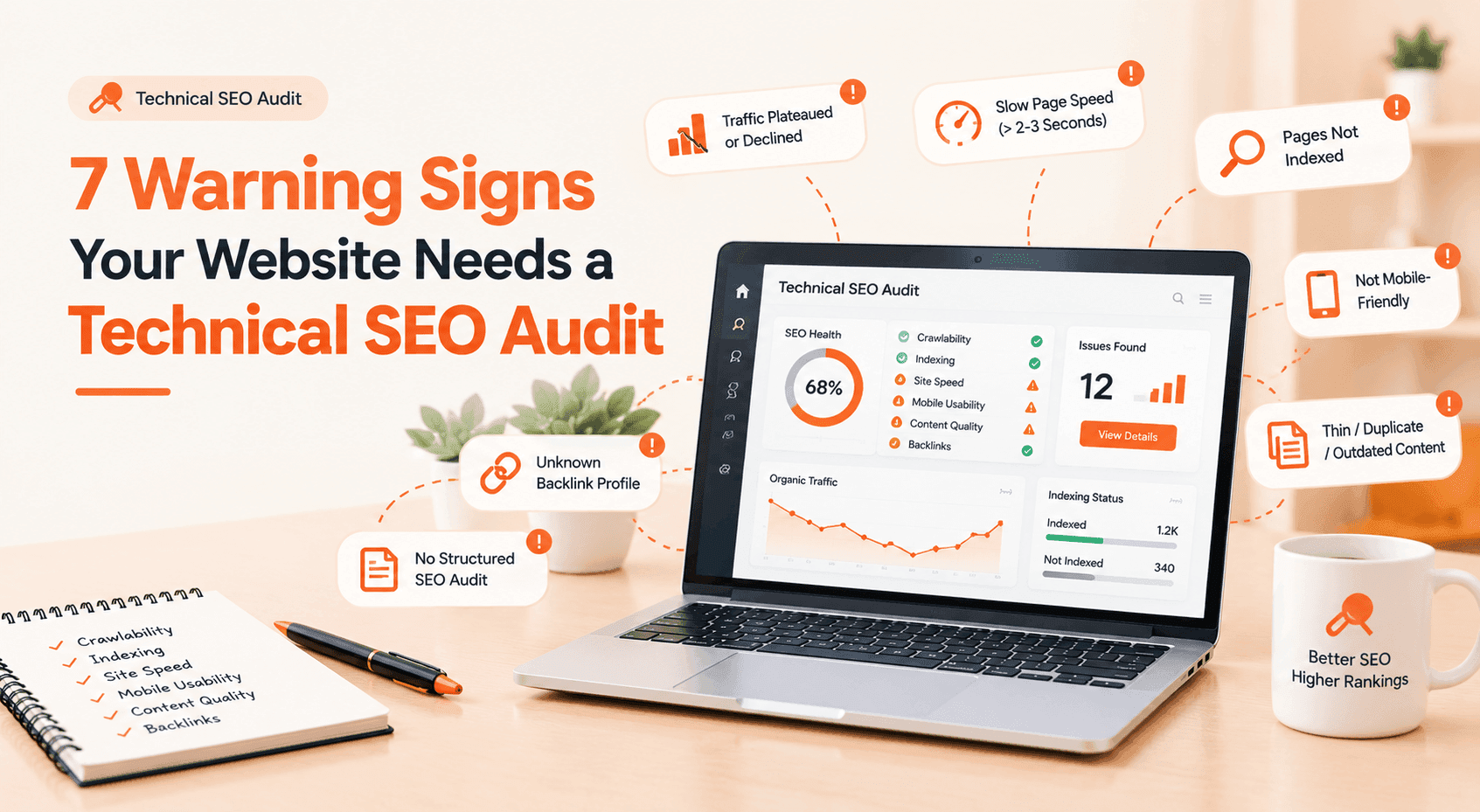
7 Warning Signs Your Website Needs a Technical SEO Audit
If you've been putting money into marketing, ads, social media, maybe even content, and your organic traffic still isn't moving, the problem usually isn't your marketing. It's your foundation. Search engines can't rank a site they can't properly crawl, index, or understand, and no amount of content or backlinks fixes that underneath.
Here are seven signs it's worth checking your site's technical and on-page health before spending further on anything else.
1. Your traffic has plateaued or declined without an obvious cause
If nothing about your business changed, no algorithm news you're aware of, no major content gap but your organic sessions have been flat or sliding for a few months, something on the site itself is often the culprit: a slow page, a broken redirect, duplicate content, or pages that quietly stopped getting indexed.
2. Pages take more than 2-3 seconds to load
Page speed is both a ranking factor and a conversion factor. A slow site doesn't just rank worse visitors leave before they see what you offer. If you haven't checked your Core Web Vitals in Google Search Console recently, that's usually the fastest way to find out where you stand.
3. You're not sure which pages are even indexed
It's common for sites to have pages that were never properly indexed, duplicate versions of the same page competing against each other, or old pages still live that should have been redirected. If you can't answer "how many of my pages are actually indexed and ranking" with confidence, that's a sign.
4. Your site isn't mobile-friendly in practice, not just in theory
Most templates are technically "responsive" now, but that's different from actually working well on a phone, tap targets too small, text that requires zooming, images that don't resize cleanly. Since most search traffic is mobile, this directly affects both rankings and whether visitors stay.
5. You have thin, duplicate, or outdated content you've forgotten about
Old blog posts, abandoned landing pages, or several pages all trying to rank for the same keyword can work against each other instead of helping. An audit usually surfaces more of this than people expect.
6. You don't know your current backlink profile
Backlinks remain one of the clearest trust signals search engines use. If you don't know roughly how many quality referring domains you have, or whether any low-quality/spammy links are attached to your site, that's a blind spot worth closing.
7. You've never had a structured technical review
This is the simplest sign of all. If your site has been live for a year or more and has never had a proper technical, on-page, and content audit, there's a very good chance there are fixable issues sitting there right now, quietly capping how well the site can perform.
What an SEO audit actually tells you
A proper audit doesn't just list problems — it tells you which issues are actually costing you visibility versus which are cosmetic, so you know what to fix first. That usually covers crawlability and indexing, site speed and Core Web Vitals, on-page elements (titles, headings, internal linking), content quality and duplication, and your backlink profile.
It's also worth pairing an audit with a look at how competitors in your space are currently winning the visibility you want, which is often the next logical step once your own site's issues are clear.
FAQ
How often should I get an SEO audit?
Once a year at minimum for most sites, and sooner if you've recently redesigned the site, migrated platforms, or noticed a traffic drop.
Will an audit fix my rankings by itself?
No, an audit identifies what's wrong. Rankings improve once the issues it surfaces are actually fixed and given time to be recrawled and reflected in search results.
Is a free online SEO checker enough?
Automated checkers are a reasonable first pass, but they tend to miss context, like which issues are actually suppressing rankings for your specific site versus generic warnings every site gets. A manual review catches what tools alone typically miss.
If any of the signs above sound familiar, an SEO audit is the most direct way to find out exactly what's happening, and competitor analysis is a natural next step once you know where your own site stands.